
at The University Art Museum, Tokyo University of the Arts
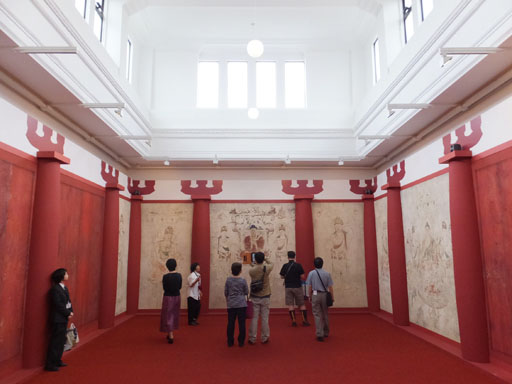
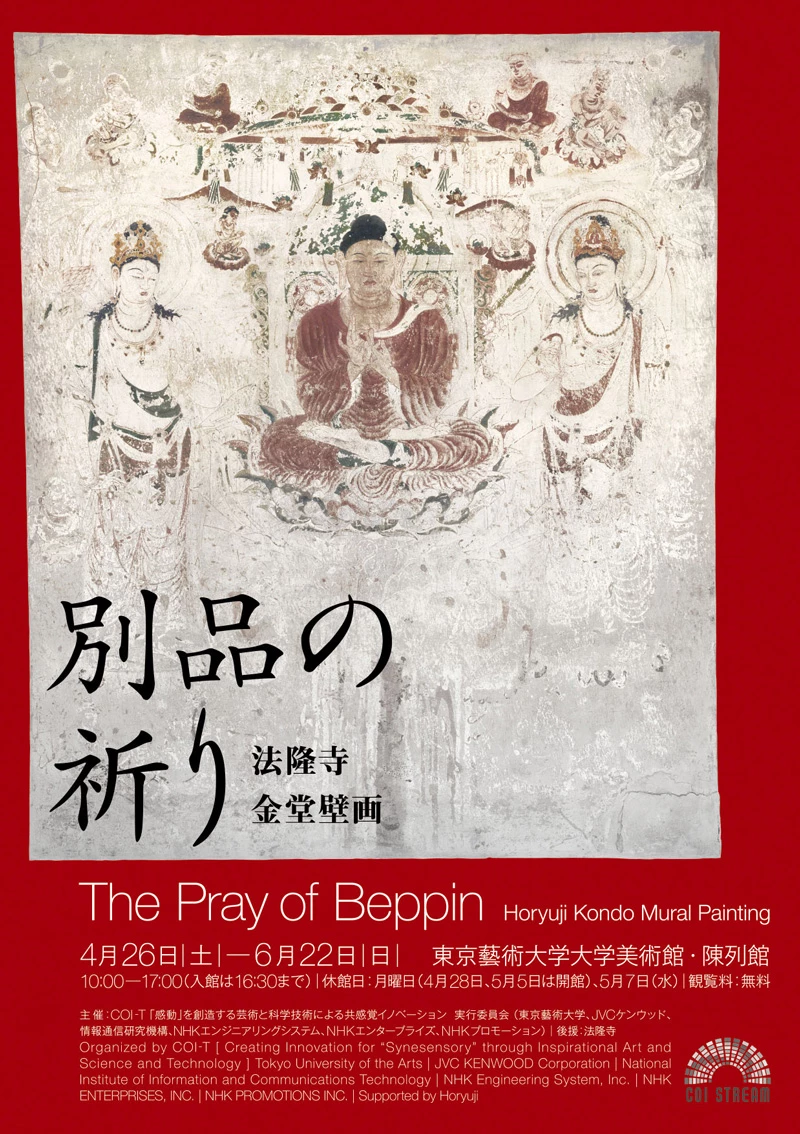
In 2014, I composed the music for Extraordinary Forms of Prayer: The Murals of Hōryū-ji’s Golden Hall, an exhibition held at the University Art Museum of Tokyo University of the Arts.
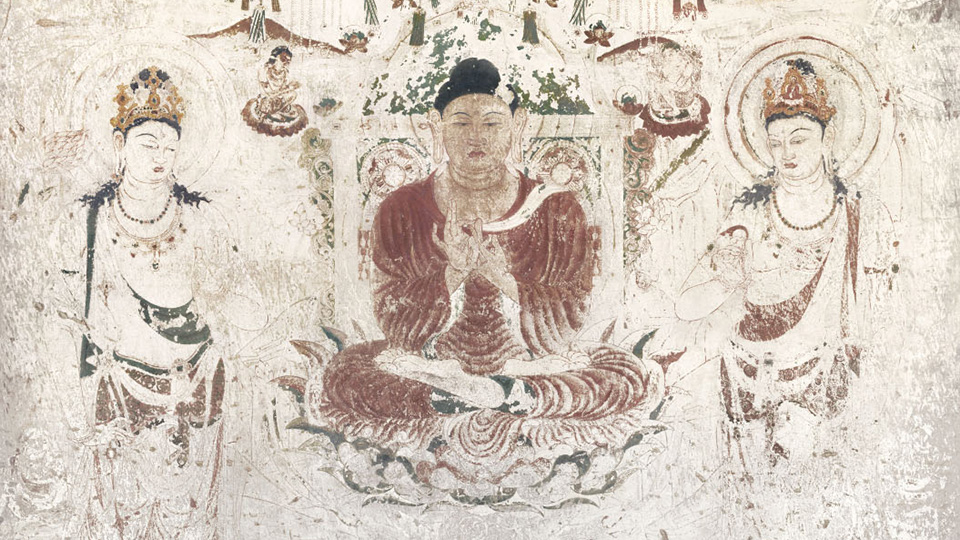
The exhibition presented full-scale reconstructions and animated interpretations of the wall paintings from the Golden Hall of Hōryū-ji, many of which were irreparably damaged in a fire in 1949.
Rather than restoring what was lost, the exhibition sought to explore how prayer, time, and memory might still be experienced in the present.
What the museum requested was not music that illustrated history, but sound capable of withstanding the weight of religious space, long duration, and bodily perception.
Two works were commissioned, with gagaku and Buddhist chant as reference points.
Instead of working from the contemporary image of gagaku as large-scale ensemble music, I chose to begin from a more reduced and elemental perspective.
Historically, instruments such as the gaku-biwa were once performed as solo voices, though such practices are rarely encountered today.
A solo work for gaku-biwa.
If the refined sonority of gagaku were compared to a body clothed in elaborate ceremonial garments, Kotsu-ka attempts to remove those layers—leaving only the underlying structure.
The aim was to reach a sound stripped of ornamentation, approaching prayer at its most minimal state: sound as presence rather than expression.
The performance was entrusted to Kahoru Nakamura, one of the few musicians actively sustaining the practice of gaku-biwa solo performance in Japan today.
While rooted in Buddhist chant, this work departs significantly from its source material.
Its instrumentation—voice, tuba, percussion, and synthesizer—deliberately creates distance from traditional form.
Rather than preserving chant as a historical object, the piece explores how prayer might dissolve into a broader, less defined field—expanding beyond religious specificity into something more diffuse and universal.
In both works, the goal was not reconstruction, but reorientation:
to ask how sound, time, and the body might reconnect in a contemporary setting without relying on explanation or spectacle.
This project was not about adding music to an exhibition.
It was an attempt to use sound as a means of bridging what has been lost with where we now stand.
Both Kotsu-ka and Banshō-ka are available via digital streaming platforms and are also included in the album Asobi.