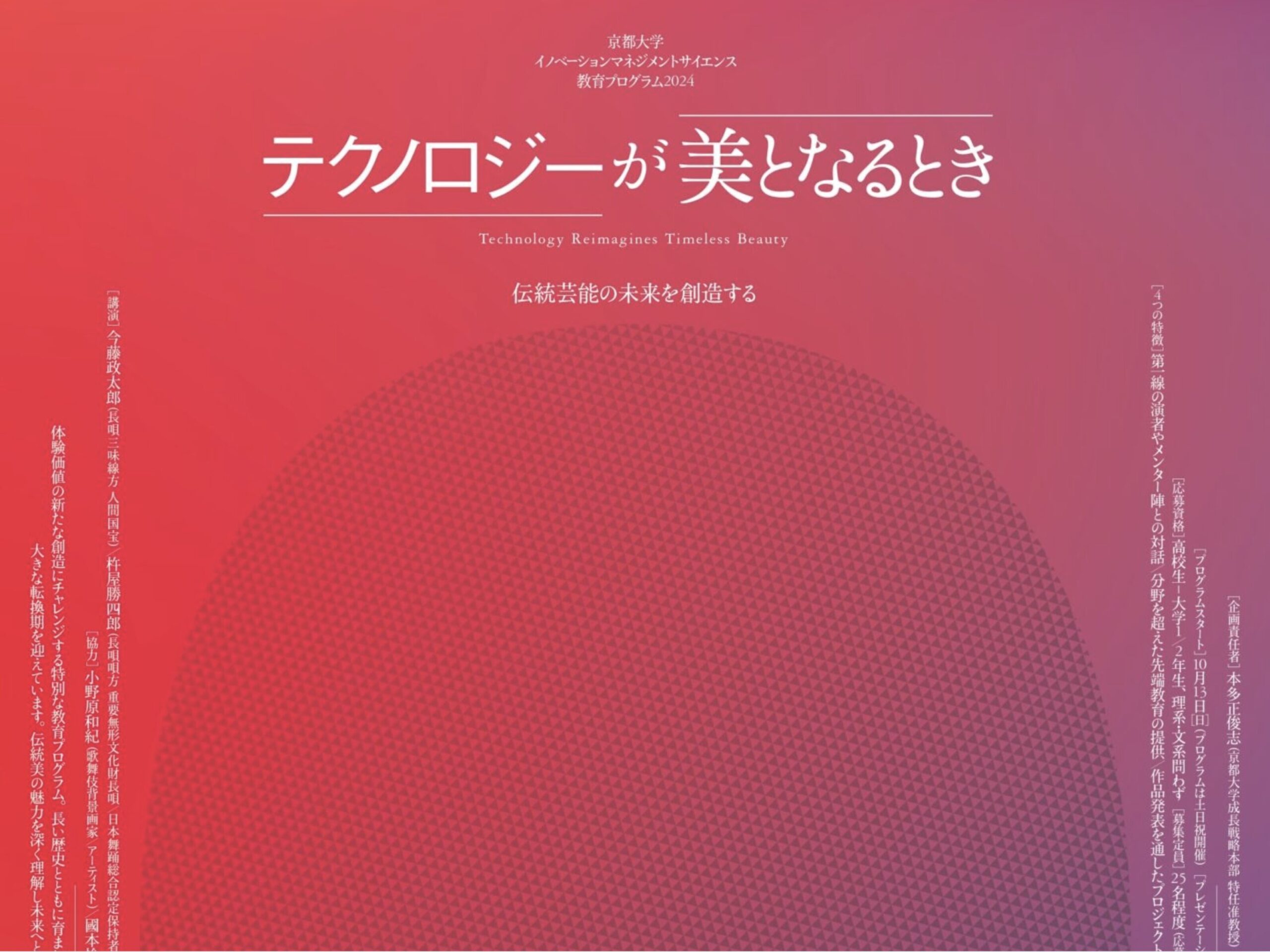

At Kyoto University, one of Japan’s leading research universities, Drifter’s CEO Taro Ishida delivered a lecture for a group of motivated students who had gathered from across Japan.
The program was organized under a research and industry–academia collaboration initiative.
According to the project’s lead coordinator, while there are many specialists who can explain traditional performing arts or music in historical terms, it is increasingly difficult to find speakers who can clearly articulate — in today’s language — why traditional music and Japanese aesthetics remain compelling, and how engaging with them connects meaningfully to the present and future for younger generations.
What was sought was not simple preservation or explanation, but the creation of an entry point where tradition could connect naturally with contemporary sensibilities shaped by technology and diverse forms of entertainment.
Drawing on his experience working on SHOGUN, where he has engaged Japanese traditional music through a scientific perspective and advanced compositional techniques, Ishida approached Gagaku and other traditional forms not as historical artifacts or sets of techniques, but as structures of thought.
The lecture examined why this music emerged in the first place, and how it arrived at its current form — carefully articulating these questions through the inherent characteristics of the music itself.
As the discussion unfolded, participants came to recognize that traditional Japanese music is built on fundamentally different design principles from the music most people listen to today — and that these foundational principles are deeply connected to the roots of Japanese culture.
Rather than being framed as something merely to be protected, tradition was shared as an intellectual resource for thinking about the future.
Through this perspective, a common axis of dialogue emerged among students and speakers from different disciplines — using music and thought as a shared language.
The session fostered a rare space where culture, technology, and contemporary thinking could be discussed together, grounded in both experience and analysis.
This lecture exemplifies Ishida’s role as a rare voice capable of bridging Japanese traditional culture, scientific thinking, and contemporary creative practice — particularly in contexts where academic rigor and future-oriented inquiry are central.
At Drifter, we support projects that go beyond explanation, creating frameworks where deep cultural knowledge can function as living insight within modern education, research, and innovation.

