
The hichiriki (篳篥) is a melodic wind instrument in Japanese gagaku. A reed made from cane is fitted to a short bamboo body. That body is about 18 centimetres long, yet the instrument has a powerful presence in an ensemble. One key to recognising its voice is enbai: the expressive movement of pitch. This introduction explains what produces the sound and offers ways to hear it without assuming prior knowledge of Japanese court music.
The hichiriki combines a bamboo tube with a reed called rozetsu (蘆舌). The measurement of roughly 18 centimetres refers to the body, not the total length including the reed. The National Theatre’s wind-instrument guide distinguishes the dimensions of these two parts.
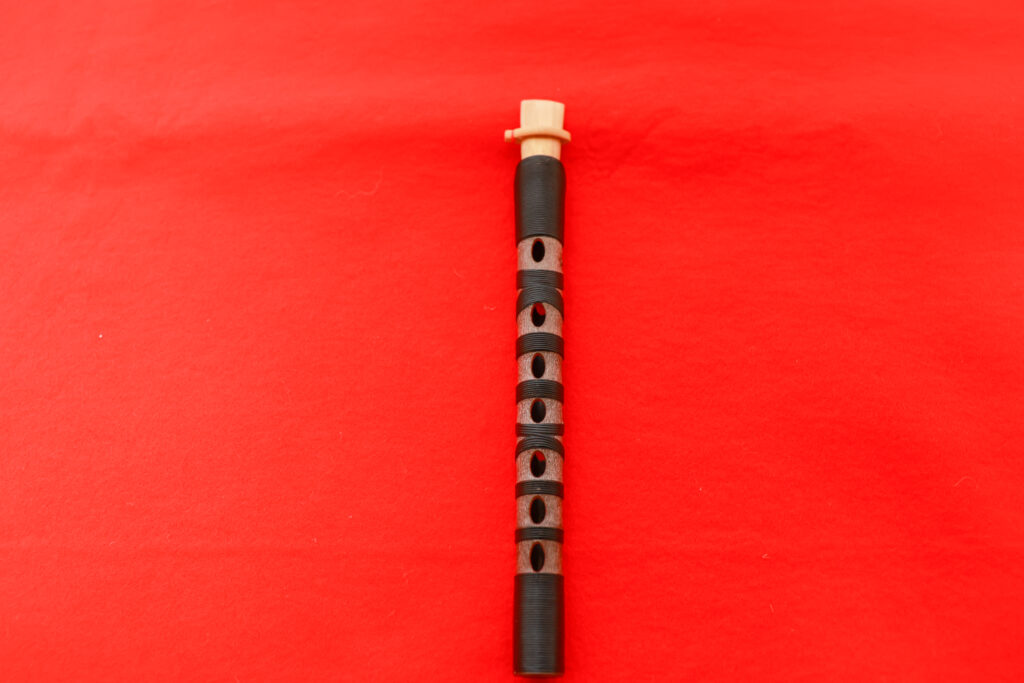
The rozetsu is made from reed cane. Its opposing surfaces vibrate in the airstream: a double-reed mechanism. Unlike a transverse flute, it does not produce sound simply by directing breath across the edge of an opening. The small size of the body tells us little on its own about its loudness or expressive possibilities.
The National Theatre’s photographs and descriptions offer a closer look at the construction. The image reproduced here is from Drifter’s existing image collection; the linked institutional material provides its own illustrations alongside the explanation.
Even with the same fingering, a hichiriki player can change pitch through breath and the position of the lips. Enbai (塩梅) is a characteristic technique of this kind. The National Theatre’s account of technique and musical role describes how it enriches the instrument’s expression within a range of approximately one octave.
When we listen as though following separate keys on a piano, we may overlook what happens while a sound moves towards the next pitch. Try hearing its onset, movement and settling as one continuous melodic event.
This is a suggestion for listening, not a claim that performers move pitches arbitrarily. Their choices belong to transmitted pieces and playing practices. A recording cannot replace a teacher’s demonstration when learning how to play.
The National Theatre describes a relatively limited pitch range alongside a strong sound that makes the hichiriki prominent in kangen and bugaku. Range means the span between available pitches; it is not the same as volume or the variety of expression a performer can create. Its demonstration helps make that distinction audible.
Hear the instrument alone first, then return to an ensemble recording. Rather than searching only for the loudest sound, follow the shape of a phrase or the way its pitch changes. These can become more reliable listening clues.
In tōgaku performed as kangen, the hichiriki and ryūteki carry melodic lines, while the shō contributes the multiple-note sonorities called aitake. The hichiriki and ryūteki do not duplicate every note and ornament identically. Their different constructions and playing techniques remain audible within the same ensemble. The National Theatre explains the hichiriki, shō and flutes separately.
A standard main piece in kangen begins with the leading ryūteki player, after which the other instruments enter. This is distinct from the beginning of the preceding netori. Listening before and after the hichiriki joins can make its contribution especially clear.
Related introductions cover the ryūteki, the shō and the overall kangen ensemble.
The hichiriki is used in tōgaku and komagaku, in saibara and rōei, and in many of the native song-and-dance forms called kuniburi no utamai. These names refer to different repertoires and performance contexts within gagaku. In its account of native vocal traditions, the National Theatre describes a softer approach that supports the singing, unlike its more prominent sound in instrumental and dance music.
Calling it an instrument that always projects a forceful melody would miss that relationship with the voice. Checking the name of the piece and its performance form helps widen our idea of what the instrument can do.
The Tokyo National Research Institute for Cultural Properties has reported on reed-cane sources, including the Kamimaki–Udono area, and on comparative studies of materials. A 2022 report records the trial manufacture of rozetsu from cane of different origins with the cooperation of hichiriki player Hitomi Nakamura.
This work shows that a musical tradition depends on more than the people performing onstage. Growing conditions, processing skills and makers’ tools also matter. It does not justify claiming that one source is the only possible material, or that every player makes the same choices.
Making and adjusting a rozetsu requires specialist knowledge. This article does not give cutting, heating or adjustment instructions. Practical questions should be taken to a performer, teacher or maker.
The National Theatre’s hichiriki page introduces a demonstration by Reigakusha. For ensemble listening, try the performances in our Etenraku guide: hear the whole texture once, then follow the hichiriki on a second hearing.
To encounter a performer’s own perspective, see Taro Ishida’s interview with Hitomi Nakamura. The conversation is in Japanese; it is presented as an artist interview, not as a replacement for the institutional explanations of technique.
This version adapts Drifter’s Japanese article. Construction and classical roles follow Japan Arts Council teaching materials; discussion of cane follows the cultural-properties institute’s report. Dimensions and range are introductory guides, not specifications for every instrument. Extended techniques in contemporary compositions and the details of individual teaching traditions require separate examination.
