
What does it mean to offer music at a Japanese shrine? Is the purpose to give an audience a beautiful performance, or is something else taking place?
In Japanese shrine traditions, music is not always performed primarily for an audience. At a Shinto shrine, it may also be offered to the kami—the sacred presences honored in Shinto—as part of a ceremony or an act of dedication.
Gagaku, Japan's centuries-old tradition encompassing instrumental music, song, and dance, has long been performed at the imperial court as well as in religious settings.
Some performances accompany the actual progression of a shrine ritual. Others take the form of public concerts held in a shrine's grounds.
These occasions may share the language of offering, but they are not identical.
This article explains what it means to offer Gagaku music at a shrine, how Gagaku relates to Kagura, and why the distinction between a religious rite and a concert matters.
It also introduces performances and cultural projects by Japanese composer and music director Taro Ishida, whose work brings historical musical forms into conversation with contemporary composition.
The Japanese term hōnō (奉納) refers to an offering or dedication. Objects, dances, and music may be presented to honor a deity or mark an important occasion.
In a shrine setting, a musical offering is understood in relation to the shrine's practices, its community, and the kami to whom the offering is addressed.
At an ordinary concert, attention is usually organized around performers and listeners: musicians present a work, an audience receives it, and applause may follow.
A musical offering can involve an audience too, but the audience is not necessarily its sole—or even primary—point of reference.
That difference changes how we think about music. When should it begin? How does it relate to the movement of the officiating priests, to the architecture, or to the silence between ceremonial actions?
Sometimes music is meant to be heard clearly as a performance; at other times, its function is inseparable from the ritual taking place.
It is also important not to assume that everything performed at a shrine is a Shinto rite.
A shrine may host a cultural event, a publicly accessible dedication concert, or a ceremony in which music forms part of the ritual itself. Each calls for a different approach.
Gagaku (雅楽) is a broad tradition of Japanese classical music, song, and dance. It developed through encounters between older Japanese forms and music and dance introduced from other parts of Asia.
Over many centuries, it has been cultivated in the imperial court and connected to ceremonies at both Shinto shrines and Buddhist temples.
Among its best-known instruments are the shō (笙), a mouth organ capable of sustaining clusters of notes; the hichiriki (篳篥), a small double-reed instrument with a penetrating melodic voice; and the ryūteki (龍笛), a transverse flute.
Depending on the repertoire, the ensemble may also include the gaku-biwa (楽琵琶), a lute; the gakusō (楽箏), a zither; and percussion instruments.
These instruments do not always appear together. Kangen (instrumental ensemble music), Bugaku (music with dance), and Mikagura (imperial ritual songs and dances) use different instrumentation and performance practices.
To call Gagaku simply “ancient music” is therefore incomplete. It encompasses several traditions, with their own histories and purposes.
For an overview of the repertoire and instruments, see the Imperial Household Agency's introduction to Gagaku and UNESCO's description of its intangible cultural heritage.
They are closely connected, but Gagaku and Kagura are not interchangeable terms.
Gagaku includes Kuniburi no Utamai (国風歌舞), a body of songs and dances of indigenous Japanese origin. Within this tradition is Mikagura (御神楽), the form of ritual song and dance transmitted at the imperial court.
However, this does not mean that every form of Satokagura (里神楽)—Kagura practiced and transmitted in local shrines and communities—is automatically classified as Gagaku.
Kagura encompasses diverse local and historical traditions. Their songs, dances, instruments, and ceremonial contexts can differ substantially.
To understand what is being performed at a particular shrine, we need to pay attention to that shrine's own history and practice, rather than assume a single nationwide format.
During a major annual festival, or reisai (例祭), musical performance may form part of a ceremony led by shrine priests.
The order of the rite, the actions of the officiants, the available space, and the shrine's customs shape what is appropriate.
Here, music may support the larger ceremonial sequence rather than stand apart as a concert piece.
Some of these performances take place within the shrine's worship hall and are attended only by invited participants or those taking part in the ceremony.
A public offering concert may take place outdoors or in another designated area of the shrine.
Visitors come to listen, and the program may include traditional Gagaku, newly composed music, or collaborations with musicians from other traditions.
Such an event can invite people to encounter the shrine and its cultural setting through music. Yet holding a concert on shrine grounds does not, by itself, make it an official ritual.
The distinction deserves to be stated clearly, not blurred for dramatic effect.
Neither form is inherently more important than the other. The essential question is what the gathering is for, and what kind of music is appropriate to that purpose.
Composer and music director Taro Ishida has been creating music involving Gagaku instruments since 2014, collaborating with musicians who perform its classical repertoire while also exploring new forms of expression.
For Ishida, working in a shrine is not simply a matter of bringing an existing concert program into a picturesque setting.
It means considering how the music relates to a specific place, its traditions, and the people who gather there. Three projects illustrate different ways that relationship can unfold.
In September 2025, Kasama Inari Shrine in Ibaraki Prefecture hosted a commemorative offering concert celebrating the completion of restoration work on its main sanctuary.
Ishida appeared with his project Taro Ishida × TOKOYO and served as music director.
The program brought together Gagaku and Western classical instruments alongside musicians from other backgrounds. The challenge was not merely to assemble a sequence of performances.
Ishida considered the sound of the shrine's architecture, the atmosphere of the grounds after dark, and how the event could communicate the meaning of offering music.
This first project led to a deeper engagement. On April 9, 2026, Ishida directed, composed, and performed music for the shrine's Grand Festival (reisai).
This time, the music took place inside the worship hall as part of the shrine ceremony, rather than as a public concert.
Four Gagaku musicians and three Western classical instrumentalists performed alongside Ishida. The program included classical Gagaku, Mikagura, and newly composed music grounded in the tradition.
The compositions had to be considered in relation to the ceremony itself—not simply transferred from a concert stage.
The movement from a publicly attended offering in 2025 to an integral part of a major ceremony in 2026 shows how a contemporary musical project can become an ongoing relationship with a place and its traditions.
Read more: Kasama Inari Shrine's 2025 offering performance and the 2026 Grand Festival project.
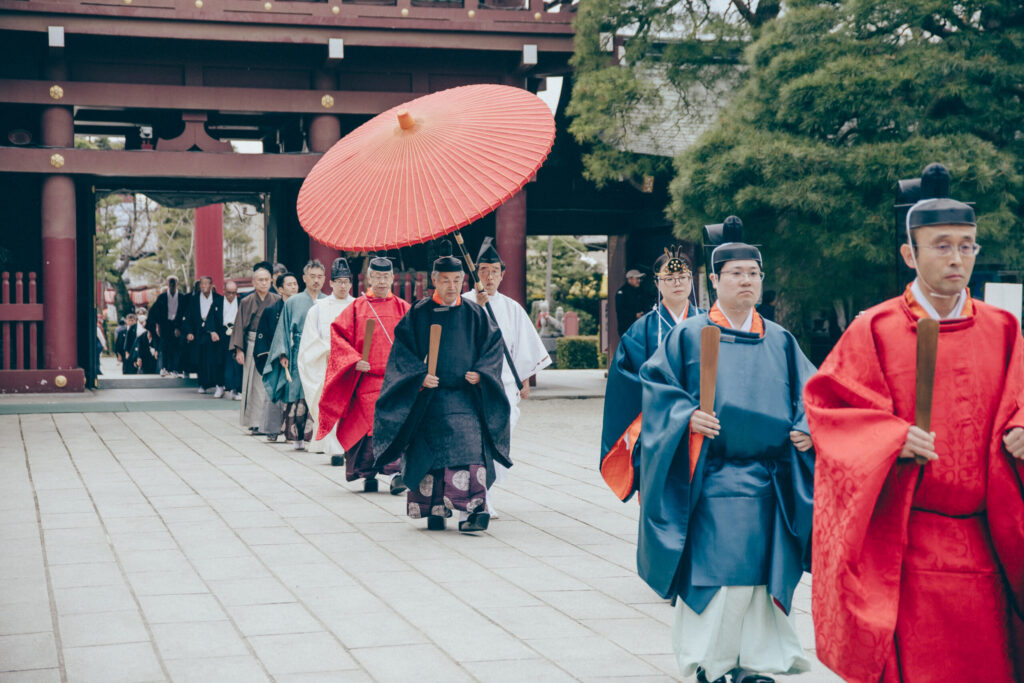
On September 22, 2026, a performance titled Oto no Afuhi — AOI was held at Kamigamo Shrine (Kamo Wakeikazuchi Shrine), a UNESCO World Heritage–listed Shinto site in Kyoto.
Ishida served as music director and contributed composition, arrangement, and performance.
The setting was the shrine's Hashidono, a historic hall spanning the flowing water of the shrine grounds.
Classical Gagaku and Kagura were presented alongside contemporary music, with musicians working across several Japanese musical traditions and modern instrumentation.
Water, insects, and the surrounding evening air were not treated simply as interruptions to the performance. They were part of the environment in which the music could be heard.
The project asked a question central to Ishida's work: What happens when an ensemble listens to the place around it, rather than trying to separate its sound from the world?
Read the performance record for Oto no Afuhi — AOI (Japanese).
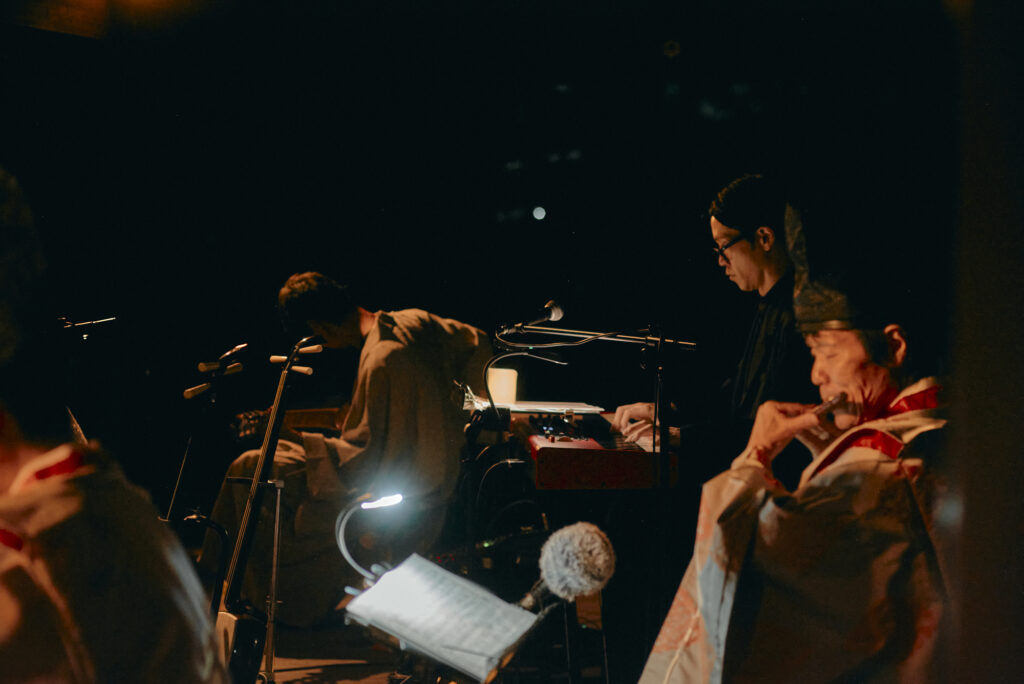
In July 2022, Ishida joined a Gagaku offering at Fukuda Hachiman Shrine (葺田八幡神社) on Shodoshima, an island in Japan's Seto Inland Sea.
The ensemble, called Domburako, brought together musicians playing hichiriki, shō, ryūteki, and gaku-biwa, with Ishida on synthesizer and the singer Oorutaichi.
The performance placed traditional instruments and contemporary musical voices in a shared setting.
Rather than treating the instruments as artifacts to be displayed, the musicians approached them as living sources of sound and expression.
The original account of the Shodoshima offering includes the musicians' names and a recording of that project (Japanese).
One way to understand these ideas is to hear the music itself.
Netori (音取) is a short introductory form in Gagaku that helps establish the character of a musical mode before a larger piece. Taishikichō (太食調) is one of the modal systems associated with tōgaku, a major body of Gagaku repertoire.
Ishida's interpretation of Taishikichō Netori retains the traditional musical core while bringing Gagaku instruments together with piano and Western strings.
The instruments are not forced into one uniform sound. Instead, their distinct musical worlds coexist and meet.
This piece is also regularly performed by Ishida's ensemble at shrine offering performances.
The video below, however, was recorded at Waseda Hōshien Scott Hall in Tokyo during a concert in 2025—not during a religious ceremony.
It offers a way to hear a work that also has a place in the ensemble's repertoire for offerings.
Watch Taro Ishida — Netori Live @ Tokyo (2025) on YouTube. For more performances and reflections on Gagaku, visit Taro Ishida's YouTube channel.
Not every musical event held at a sacred site is itself a religious offering. The following projects are included because they demonstrate other ways Gagaku and Japanese musical thought can be encountered in places shaped by religious history. It is important to describe each event for what it actually was.
At the international business gathering Kyoto 2.0, hosted at Shimogamo Shrine, Ishida delivered a lecture on shoshin—often translated as “beginner's mind.” Using Gagaku as a starting point, he explored Japanese ideas about nature, time, and ways of perceiving the world.
The lecture was followed by a Gagaku performance by the Heian Gagakukai ensemble. Ishida's role was to lead the lecture, not to perform the music or conduct a shrine ritual. The event connected listening with cross-cultural discussion.
Read the English account of the Shimogamo Shrine lecture.
Ishida served as music director, composer, arranger, and performer for True Colors Festival SPECIAL CONCERT 2025: Kyōmei no Utage, staged at Zōjōji, a Buddhist temple in Tokyo.
The concert brought together artists with different musical backgrounds and abilities, creating a shared performance around the idea of resonance.
It was a contemporary cultural concert, not a Shinto rite or an example of Gagaku being offered during shrine worship.
Its relevance here lies in how music was conceived in relation to a historically significant venue and a diverse group of participants.
See the concert's project record (Japanese).
On November 3, 2025, Ishida appeared in Deep Listening, part of Audio-Technica's Analog Market at Tsukiji Hongwanji, a Buddhist temple in Tokyo.
The event's program, Animistic Music | Gagaku Electronics, combined live Gagaku instruments, keyboard and electronic sound, and conversation.
It explored what it might mean to encounter an old musical tradition through the ears and technologies of the present.
This was a public cultural event rather than a Buddhist liturgical ceremony. Read the English project description.
At Ryōdenji Temple in Machida, Tokyo, Ishida led a session of the educational program 500 Years School on October 17, 2026.
Gagaku musician Ko Ishikawa performed on the shō and introduced traditional Japanese vocal music. Participants listened to the instrument and learned songs themselves.
Ishida was responsible for the lecture and discussion; Ishikawa was the performer.
The distinction matters: this was not a dedication concert, but a participatory encounter with music—an opportunity to discover how sound, singing, and the body can connect contemporary listeners with older practices.
See the program announcement (Japanese).
For a first encounter, you do not need to recognize a melody or understand every instrument.
Instead, try listening for the way tones overlap and recede, how different instruments seem to breathe at different speeds, and how the space changes as sound fades.
Outdoors, the sound of wind, water, birds, or insects may be audible alongside the musicians. We normally call such sounds “background noise.” But what happens if we hear them as part of the same moment?
Ishida has suggested that Gagaku can be heard as music that seeks to become one with nature. This is his own artistic interpretation, not a claim that every Gagaku tradition has one fixed philosophical meaning.
It is a way of approaching the sound: rather than demanding that music tell us a story, we can listen to the relationships it reveals.
For a contemporary listener, that shift in attention can be as meaningful as learning a new historical fact.
For a shrine, arts organization, or cultural producer considering a musical offering, the first question is not necessarily which instruments to hire. It is what the event is meant to honor or accomplish.
Where music is intended for an official ritual, decisions about ceremonial appropriateness belong to the shrine and its religious authorities.
Artistic collaboration begins with listening to those needs, not by treating a centuries-old tradition as a blank stage for contemporary ideas.
It depends on the occasion. Some offering concerts are open to visitors, while music performed within a shrine's formal ceremony may be limited to invited participants. Check the shrine or organizer's event information.
Not necessarily. Gagaku is a broad tradition encompassing instrumental music, dance, and vocal forms.
Kagura refers to traditions of songs and dances offered in connection with the kami. Mikagura, the imperial court tradition, is included within Gagaku's Kuniburi no Utamai, but regional Satokagura traditions are not all classified as Gagaku. Practices vary among shrines and communities.
No. Public offerings sometimes combine traditional repertoire with new works or contemporary instruments.
New music can also be introduced within a ritual context, but only through careful consideration of the shrine's customs and the wishes of its authorities.
Yes. Gagaku has historical connections to both Shinto and Buddhist institutions. But a contemporary concert held in a temple is not automatically a Buddhist rite.
The purpose and format of each event must be understood on their own terms.
No. The video embedded above was filmed at a Tokyo concert in 2025. Ishida and his ensemble also regularly include this piece in their shrine offering performances, which is why it is presented here as a way to hear music that bridges both settings.
Taro Ishida is a Japanese composer and music director whose work crosses Gagaku, Western classical instruments, electronic music, and music for visual and spatial experiences.
Through Drifter Inc., he develops projects that engage not only musical technique but also the cultural meaning of a place and the people who gather there.
His projects include Gagaku offering performances, newly commissioned works, music direction for festivals and cultural programs, and talks and lecture-concerts that introduce Japanese music to audiences in Japan and abroad.
For those interested in the sound itself, a good place to begin is the live performance of Taishikichō Netori and the Taro Ishida YouTube channel.
Readers exploring the tradition more broadly may also enjoy What Is Gagaku? An Introduction.
For inquiries about performances, new compositions, music direction, lectures, or international cultural collaborations, please visit Drifter's English contact page. Projects can be discussed from an early planning stage.
To offer music is also to ask how a tradition might be carried forward. When old instruments sound in a living place, history is not simply being reproduced: it is entering the present.
