
For me, music has never been only something to enjoy listening to. It has been a door, or perhaps a window, onto worlds I did not know existed. Through music, I have encountered unfamiliar cultures and ways of thinking, and my own sense of what is possible has gradually grown. As a musician, I hope that something I make or share can open such a door for somebody else.
My name is Taro Ishida. I am a composer and music director based in Japan. I write for instruments associated with gagaku, the centuries-old tradition of Japanese court music, as well as for piano, electronic sound, films and particular spaces. But I did not set out to become a musician.

Contents
When I was studying classical Chinese literature at Sophia University in Tokyo, I had no intention whatsoever of entering the music profession. In fact, making music had not occurred to me as a possible path. Then, just before graduation, the wish to become a composer arrived as suddenly as a bolt of lightning. I still cannot explain why. The desire came first; the reasons, if there were any, came later.
After university, at the age of 23, I began working in a record shop in Ikebukuro, a neighbourhood of Tokyo. I chose the job because I wanted to hear as much music as possible. This was before streaming gave us immediate access to enormous catalogues, and being surrounded by records seemed like a remarkable opportunity.
The reality was less romantic. I worked from morning until night, and on my days off I was often too tired to do anything. My knowledge of music kept expanding, but I was not making anything myself. I wanted to become a composer, yet I had no idea how to begin.
During a break one day, I hurried out of the shop and into a nearby bookshop to look through music university entrance examinations. Nearly all of them seemed impossibly difficult. One, however, included a chance to present an original idea. It was the examination for Tokyo University of the Arts.
That did not make the examination easy. For roughly six months I studied desperately: practising piano, preparing for ear-training tests, and buying and reading every music book I could find in the nearby second-hand shop.
For the creative presentation, I made a computer program inspired by the sculptor Isamu Noguchi and his idea of sculpture that ages and decays. Musical instruments change over time: their materials grow older, and even their sound may change. A digital sound, by contrast, can remain identical whenever it is played. That permanence is an extraordinary strength. But what if, in some sense, it is also a limitation?
I made a program in which sounds stored inside a computer would slowly alter over a hundred or two hundred years. That was the work I presented at the entrance examination.
I was admitted, but found myself among people who had both talent and many years of musical training behind them. The distance between their experience and mine was formidable. I went on to graduate studies, learning composition, musicology and electronic sound.
While at university, I had taken a few lessons on the shō, the small mouth organ used in gagaku. At the time, I regarded this as useful knowledge about a tradition that had little to do with my own work. I never imagined composing for its instruments.
That changed in 2014, after I had completed graduate school. I was asked to make music for an exhibition concerning Hōryūji, a historic Buddhist temple, at a gallery associated with my former university. At our meeting, the professor simply told me: ‘Gagaku on the first floor, shōmyō on the second.’ Shōmyō is a tradition of Buddhist chanting.
The deadline was two months away. I felt completely at a loss. I began studying as intensively as I could and composed Bone Song (骨歌), my first work using gagaku instruments.
I was hesitant at first, but the project changed the direction of my work. I began to hear possibilities within gagaku that had not been visible to me before. With each subsequent piece, I tried something new and learned from the musicians performing it.
At that time, I was hardly known as a composer. Yet the gagaku performers listened seriously to my ideas and gave their time generously to experiments whose results none of us could predict. I remain deeply grateful. Without their patience, openness and commitment, I doubt I could have continued making this music.
I have written more about this early experience in an essay on composing for gagaku (in Japanese).
I sometimes think of music as a plant. The striking appearance of an instrument or the colour of its sound may be the flower. Below it lie the ways notes and rhythms are organised; deeper still lie the culture and ideas from which the music has grown. Those deeper roots interest me most.
Combining the sounds of instruments from different traditions can be exciting in itself. But I want to ask what happens when we also bring together their different experiences of time, their approaches to breathing and listening, and their assumptions about what music can be. When musical roots meet, what might grow?
For me, gagaku suggests an aspiration to become part of nature rather than to stand apart from it. That is a personal way of listening to and understanding the tradition, not a definition that I would impose on every performance. Its sense of time, breath and overlapping sound continues to influence my work.
TOKOYO, music bringing gagaku instruments together with strings and piano, is one attempt to explore that meeting.
Listen to the TOKOYO album on YouTube.
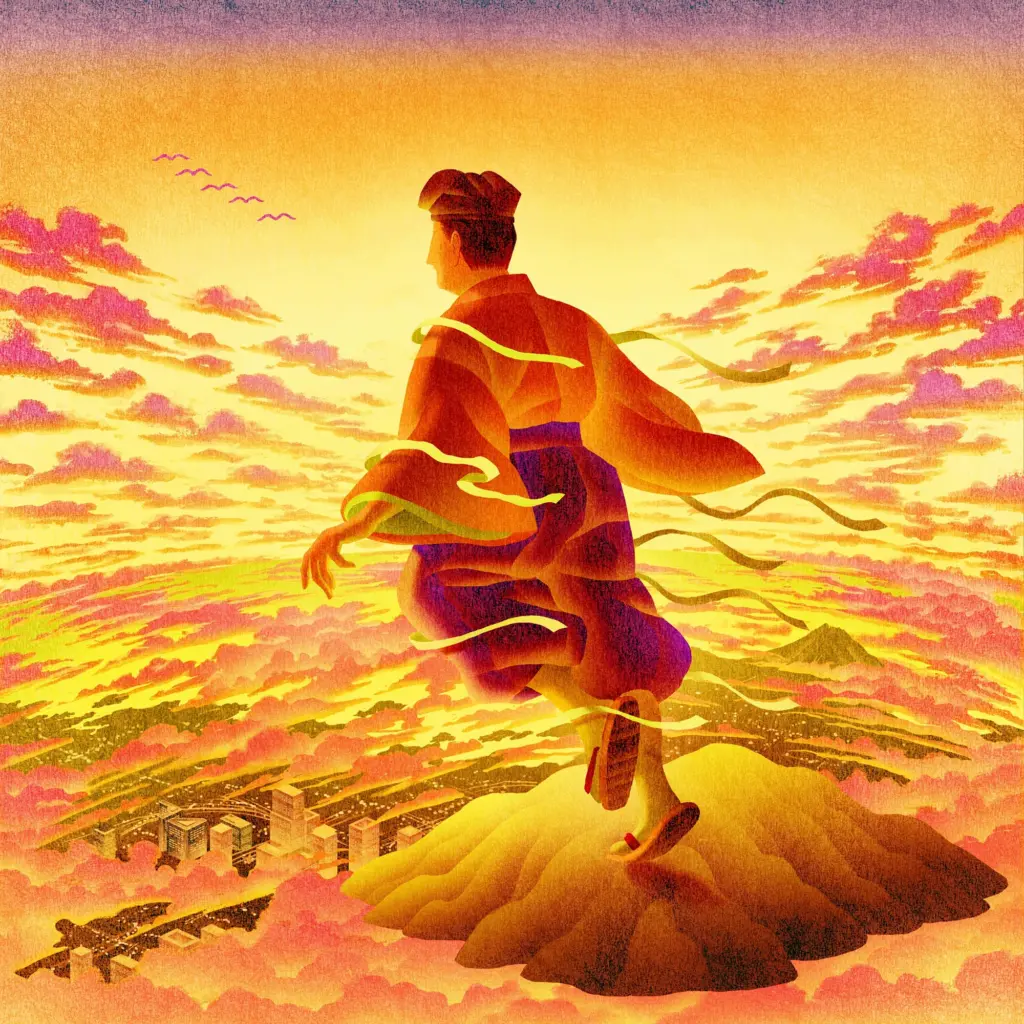
Where music is heard matters just as much to me. A concert hall, a shrine, a museum, a film and a public space each create different relationships between sound, time and the people present. I try to consider those relationships as part of the composition, not simply as the setting in which a finished piece is played.
One of my favourite parts of composing begins after I have written the music down. When we worked on TOKOYO, I made scores and computer mock-ups, listened to the performers play them, and rewrote passages again and again.
The sound I imagine is not always the sound that emerges in a room. Musicians teach me things that a page of notation or a computer cannot. Revising becomes a conversation with the people who bring the notes to life.
Even when the recording or score has not changed, my own ears have. Something that seemed right yesterday may trouble me today. I like returning to the same music on different days and in different states of mind. Gradually, the piece becomes something none of those individual moments could have produced alone.
My work became more widely known after my involvement in the television drama SHŌGUN, for which I worked on arrangements of Japanese traditional music and recordings in Japan. That experience opened up further opportunities to create with gagaku musicians. But the work itself still grows from the same thing: listening, questioning, and making adjustments together.
Through years of working with gagaku, I have come to feel more strongly the value of the musical culture itself. I initially approached it through the practical task of writing a piece. The more I learned about its history and encountered the people who sustain it, the more I wanted others to discover its possibilities too.
That is one reason I speak about music and culture on YouTube. A composition can communicate things that words cannot, but a conversation can also offer a way in. A listener might become curious about a musical instrument, then find themselves reading about history, art or an unfamiliar idea. I know how easily that can happen, because music has opened those paths for me.
I hope to create music, but also occasions for encountering music. If a talk, a performance or an unexpected sound becomes somebody else's doorway into another world, that is meaningful work to me.
I do not know exactly what kind of music I will be making in the years ahead. Looking back, there was never a perfectly planned route. Encounters, invitations and unforeseen projects led me to learn something new; my music changed with them.
Along the way, there were always people who were willing to create with me, listen to me, and offer an opportunity. I could not have reached this point alone. I want to carry that gratitude forward, keep making music, and share something worthwhile with the world, however modest that contribution may be.
On my YouTube channel, I share performances, works and conversations about gagaku and other musical cultures. Many spoken videos are in Japanese; the music needs no translation.
You can also find my recordings on Spotify and Apple Music.
Read this essay in other languages: Français · Deutsch · Español · Italiano · Português · Русский · 한국어 · 简体中文 · 繁體中文 · العربية · हिन्दी · 日本語(原文)
