
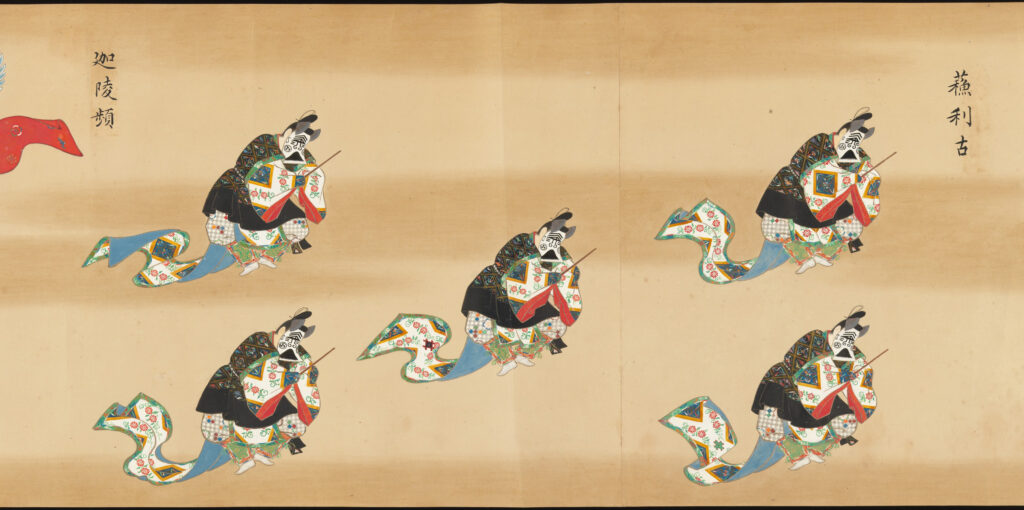
Gagaku is a Japanese tradition of music and dance with a history spanning more than a thousand years.
Gagaku is a mixture of the ancient indigenous music of Japan and influences from the Korean peninsula and mainland China that flowed into Japan about 1,400 years ago, and matured into a form unique to Japan during the Heian period (794-1185).
Hereditary musician families played an important role in transmitting gagaku, alongside institutions and other communities of performers. Oral teaching, notation and practical training have all contributed to its transmission. The repertoire and performance practices have also changed, been reorganised or been revived over time.
Gagaku offers a valuable encounter with a living musical tradition. A performance today connects us with inherited practices, without being an exact sonic record of the Heian period.
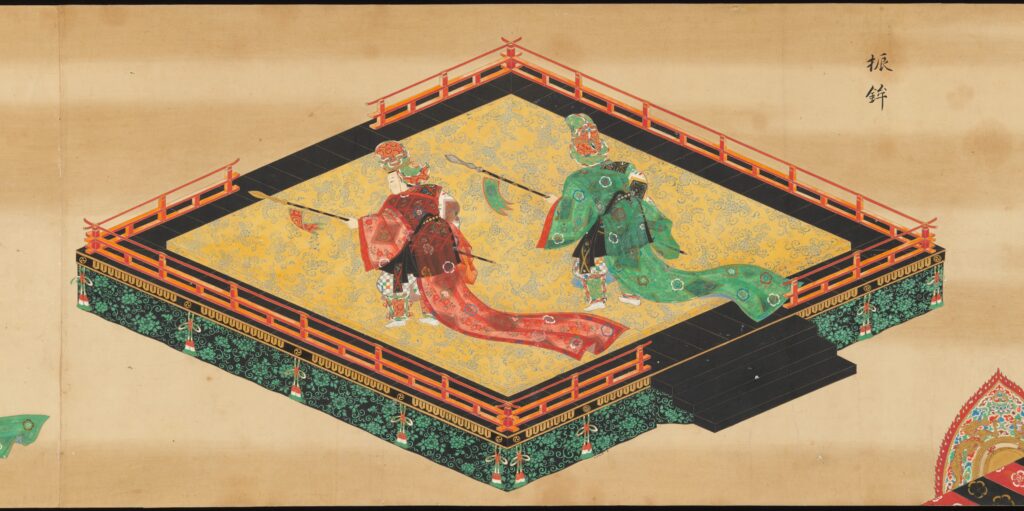
Gagaku has developed in dialogue with courtly life, ritual and religious thought. In our own work, it also prompts questions about listening, nature and the relationships between sounds. These are ways of engaging with the music, rather than a single historical philosophy shared by every performer.
A variety of distinctive instruments are used in Gagaku.
The main ones are as follows
Sho / Hichiriki / Ryuteki, Komabue, Kagurabue / Biwa /
So / Wagon / Kakko and san no tsuzumi / Taiko / Shoko
The instruments are used in different combinations: a kangen ensemble, komagaku dance music and mikagura do not share one fixed instrumentation. Explore the instruments, their sounds and their roles.

We want to play a role in connecting people around the world with traditional Japanese music.
For a project with Japanese traditional music, explore Drifter’s recording and composition work, concert programmes and lectures with live demonstrations.
