
When people speak about gagaku, Japan’s court music and dance traditions, the conversation usually turns to performers, repertory and centuries of transmission. Far less often do we ask a simpler question: who makes and repairs the instruments that allow this music to be played?
The shō mouth organ, the small double-reed hichiriki and the transverse flute known as the ryūteki require specialist craft knowledge. Without people who can build and maintain them, the continuity of performance itself becomes harder to sustain. Yet preserving methods on paper is not enough. Craftworkers must also be able to earn a living and, where they wish to, train the next generation.
This article examines what official documents and published interviews actually tell us, distinguishes historical survey data from the situation today, and considers what still needs to be investigated. For an introduction to the instruments themselves, see our guide to gagaku and kagura instruments.
Contents
According to Japan’s Agency for Cultural Affairs, the techniques of making and repairing gagaku wind instruments were designated a Selected Conservation Technique on May 4, 1976. This designation recognises specialist skills indispensable to the preservation of cultural properties (Agency for Cultural Affairs: Gagaku Wind-Instrument Manufacture and Repair).
The official account accompanying the designation already referred to a decline in the number of makers, difficulty obtaining materials such as smoke-aged bamboo, and the lack of successors. The problem did not suddenly arise in the 2020s.
One qualification matters: when this historical description refers to the “present,” it means the period in which it was written, not the number of active makers in 2026. More recent evidence is essential before making any claim about today’s workforce.

A 2017 report by the Tokyo National Research Institute for Cultural Properties records the work of several makers and repair specialists, including 菊田雅博 (菊田雅楽器店), 谷田直道 (古弾) and 久松誠 (和音工房). These are names documented at the time of that research; the report should not be treated as a current directory of active workshops (Research report, 2017, pp. 42–47; Japanese PDF).
A document submitted to the Council for Cultural Affairs in 2021 by Emi Maehara of the Tokyo National Research Institute for Cultural Properties summarised field research conducted between April 2017 and March 2021. It addressed the status and challenges of craft techniques supporting the performing arts (Agency for Cultural Affairs, 2021 council document, particularly pp. 4 and 9; Japanese PDF).
Of seven surveyed cases relating to the making and repair of gagaku wind instruments, only two had a successor at the time of the survey. Looking across the 44 surveyed cases of instrument-making and related conservation techniques, 13 had a successor—approximately 29 percent.
These numbers must not be read as a census of every maker in Japan. Nor do they establish how many successors exist in 2026. They show that succession was difficult in a significant proportion of the specific practices the researchers investigated.
The report also makes clear that the challenges are connected: it can be difficult to sustain instrument making as an occupation; suitable materials and tools may be scarce; and there may be no one available or able to inherit the knowledge.
An interview published by the Japan Culture Promotion Foundation in October 2025 offers one maker’s perspective. A ryūteki craftsman identified as 藤脇 spoke of having no successor at the time and of the time-intensive nature of making and repairing instruments, which limits the number of commissions one person can complete (Interview with the ryūteki maker, October 2025; Japanese).
This is the experience of a particular maker, not evidence that every instrument maker has the same income or circumstances. His situation may also have changed since the interview was published.
The interview described a new flute priced at approximately ¥200,000 and a repair at approximately ¥30,000 in that maker’s practice at the time. A price alone tells us little about earnings unless we also consider hours of work, materials, tools, workshop expenses and the limited number of instruments that can be made. These were individual examples reported in 2025, not a market-wide price list.
The foundation also published a photographically illustrated account of the ryūteki-making process; Japanese. It offers a glimpse of the care involved in selecting bamboo, shaping the bore and making finger holes—work largely invisible to the concert audience.
This raises questions that demand better evidence. How frequently do makers receive new orders or repair requests? Are the fees sufficient to support their working hours and overheads? Is there enough financial room for a maker to teach an apprentice? If a profession depends entirely on the personal sacrifices of its most experienced practitioners, it is difficult to make it an attractive livelihood for a new generation.
The research institute’s survey noted difficulties in acquiring suitable smoke-aged bamboo (susudake), madake bamboo and specialised saws used in bamboo work. The required dimensions and physical properties vary with the instrument; not every piece of bamboo can serve as an adequate substitute.
The reed used for the hichiriki’s mouthpiece presents another issue. Around the Udono reed beds in Takatsuki, Osaka Prefecture, access to appropriate reeds has become inseparable from the conservation of their growing environment. Instrument making depends not only on an individual craftworker’s hands but also on those who maintain material supplies and specialist tools.
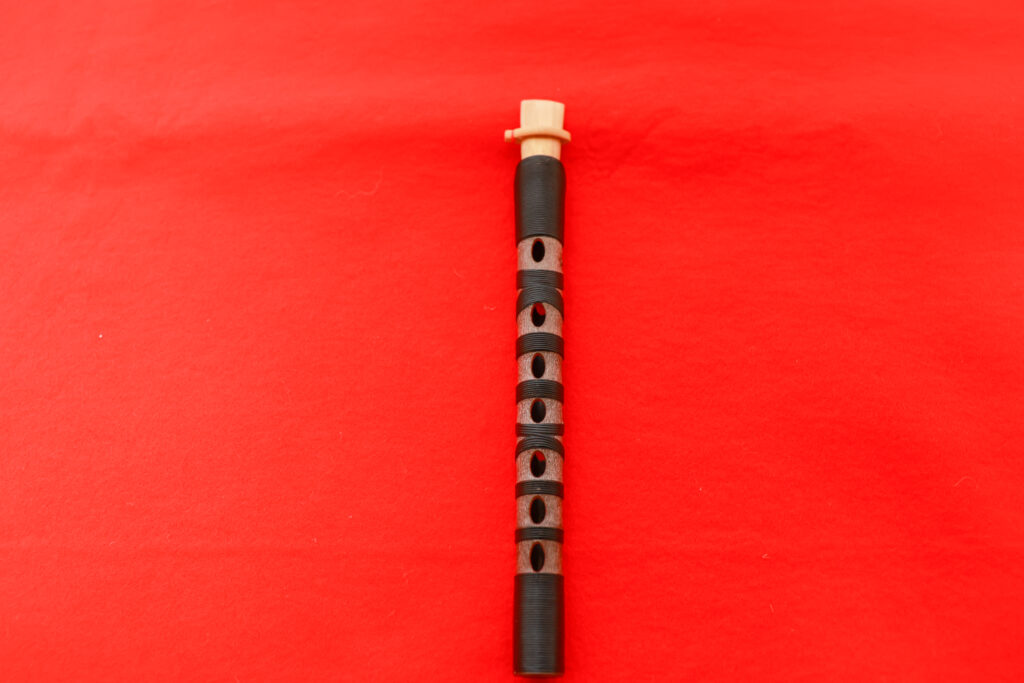
This is not a field in which nothing is being done. In June 2025, the Gagaku Association, local organisations and Takatsuki City established a consortium to conserve reeds used for hichiriki mouthpieces. The Agency for Cultural Affairs and the Ministry of Land, Infrastructure, Transport and Tourism participated as observers. A ceremony marking the start of reed-growing activities was held in April 2026 (Takatsuki City’s 2026 report; Japanese).
The Tokyo National Research Institute for Cultural Properties has also reported on coordination between organisations and public support for conserving raw materials (Research institute activity report, February 2026; Japanese). Any new initiative should first understand and respect the work already being done, then look for needs that remain unmet.
The following are questions for further investigation, not solutions whose effectiveness has already been demonstrated. Before proposing a scheme, it is essential to listen to the makers themselves.
Performers, shrines, temples and educational institutions need reliable ways to find the specialists who can build or repair the instruments they use. Orders need to reach those specialists, with fees and schedules that respect the time and skill involved. Public attention matters only if it can also translate into meaningful opportunities for work.
Learning a specialist craft can take years. Supporting that process may require paying for the maker’s teaching time as well as making an apprentice’s training period financially possible. But not every craftworker necessarily wants an apprentice, and the preferred way to pass on skills will differ. Their wishes must come first.
Careful documentation can explain the tools, materials and time required for each instrument and make the expertise behind it easier to appreciate. Any public notice about commissions or apprenticeship opportunities, however, must be checked with the maker and published only with their consent. Accurate information can help connect performers, commissioners and prospective learners.
Published documents alone cannot establish the total number of people making and repairing gagaku instruments in Japan in 2026, the number of successors for each instrument, actual earnings, apprenticeship arrangements or the capacity of workshops to accept new commissions. Makers of string instruments, percussion instruments and specialist components must be investigated separately rather than being absorbed into figures for wind instruments.
To carry the sound of gagaku into the future, the practice of making its instruments must continue alongside the practice of playing them. This article is a starting point: a commitment to examine documentary evidence carefully and, in future, to listen directly to instrument makers and performers.
