
These six examples introduce different sides of my work with Japanese traditional musicians: recording inherited repertoire, writing new music and developing collaborative performances. I am Taro Ishida, composer and music director at Drifter. Each project begins with the performers and the sounds that the work needs.
On this page
This audio example comes from a recording of Shunnōden no Yūsei, a section of the classical gagaku repertoire. Listen to the length of the phrases and to the way individual sounds become part of the ensemble texture.
This shō-only recording lets you hear a part that normally sits within a larger ensemble. It is an opportunity to listen closely to changes of harmony, breath and continuity. It is not a complete ensemble performance of Etenraku.
Read more about Etenraku and its instruments
Kotsuka was composed in 2014 for the Hōryū-ji exhibition at Tokyo University of the Arts. It was an early step in my continuing exploration of Japanese traditional instruments as part of my own compositional language.
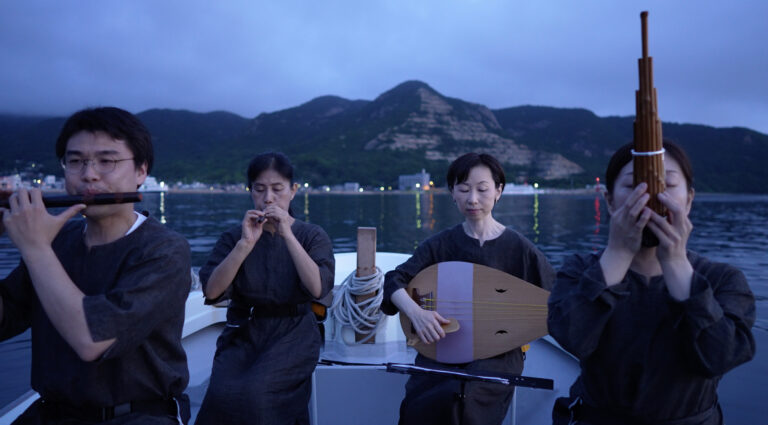
This video documents a dedication performance on Shōdoshima in 2022. A performance in a particular landscape or ceremonial setting asks different questions from a studio recording: how the music relates to the place, the occasion and the people present.
Domburako is my collaboration with Oorutaichi. This work was filmed in the Kinomata Valley in Nasu-Shiobara in early spring 2021. I played gong, Oorutaichi played an ancient-style koto, and Yuuki Mashiko created an ink painting during the performance. Ryūteki by Yoshiyuki Izaki was added to the recording.
Film: Yuuki Mashiko and Miyuki Muroi. Full project credits (Japanese).
Asobi was composed in 2018 for the Tokyo Metropolitan Teien Art Museum exhibition Indigenous Brazilian Chairs: Wildlife and Imagination. Kahoru Nakamura performs the gaku-biwa part. Here a single instrument carries the piece, with its attacks, resonances and intervals of silence.
Read about the exhibition and composition


More recent work includes Japanese traditional music arrangements and recording coordination for FX’s SHŌGUN, and my album TOKOYO. For SHŌGUN, the original score was composed by Atticus Ross, Leopold Ross and Nick Chuba. Read about the recording work in Japan.
Drifter works with producers and cultural organisations on Japanese instrument recording, arrangement and original composition. Our recording and composition overview explains the approach and the information that helps us plan a project.
Tell us about the production, the sound you are looking for and your schedule through our contact page or mail@drftr.co.jp.
